What Is a CNC Hobbing Machine? A Complete Guide for Gear Manufacturers
A CNC hobbing machine is a specialized gear-cutting machine tool that uses a computer numerical control (CNC) system to automate the hobbing process — one of the most efficient and widely used methods for producing gears at scale. Whether you are manufacturing spur gears, helical gears, worm gears, or splined shafts, a CNC gear hobbing machine delivers the precision, repeatability, and throughput that modern industry demands.
This complete guide is designed for gear manufacturers, procurement engineers, and industrial buyers who want a thorough understanding of what CNC hobbing machines are, how they work, what types are available, and why they have become indispensable in precision gear manufacturing.
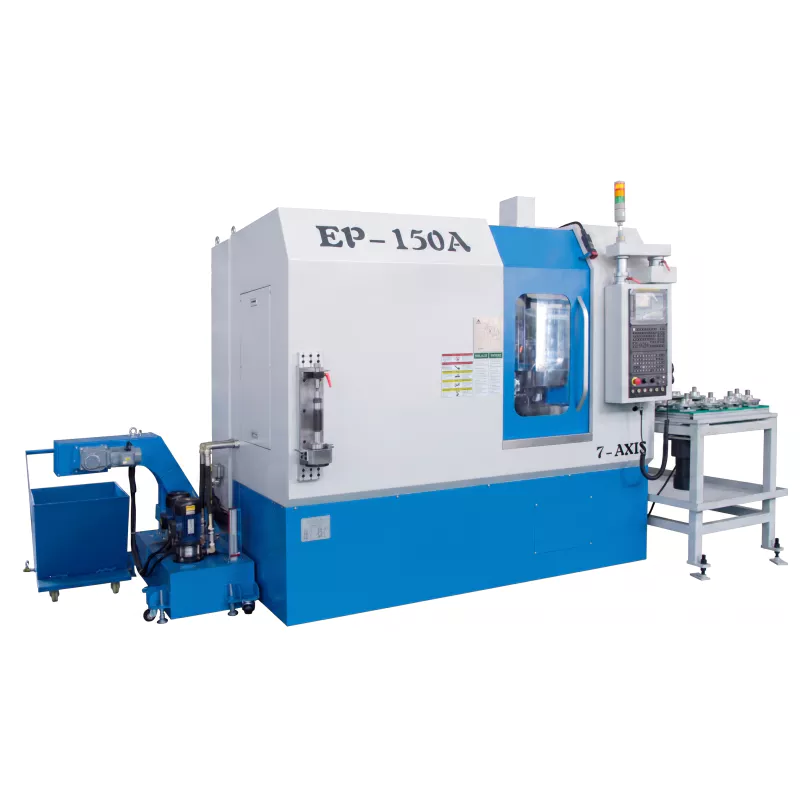
The Basics: What Is Gear Hobbing?
Gear hobbing is a continuous gear-generating process in which a multi-tooth cutting tool called a hob rotates in a synchronized relationship with the workpiece (gear blank). As the hob rotates and feeds axially across the gear blank, each tooth of the hob successively removes material, gradually forming the gear tooth profile through a series of cuts.
Unlike form-cutting methods, hobbing generates the involute tooth form through the relative motion between hob and workpiece — making it inherently accurate and highly productive. This is the reason hobbing remains the dominant process for high-volume gear production worldwide.
⚙ Key Terminology: Hobbing Process Glossary
- Hob: The rotating cutting tool with helically arranged cutting teeth.
- Gear blank: The raw workpiece to be cut into a gear.
- Module (m): A metric measure of gear tooth size — the ratio of pitch diameter to number of teeth.
- Helix angle: The angle of the gear teeth relative to the gear axis.
- Axial feed: The linear movement of the hob along the gear axis during cutting.
- Synchronization ratio: The precise rotational relationship maintained between hob and workpiece by the CNC controller.
What Makes It “CNC”?
Traditional hobbing machines relied on mechanical gearboxes and change gears to synchronize hob and workpiece rotation. A CNC hobbing machine replaces these mechanical linkages with servo-driven axes and a digital controller. This brings several transformative advantages:
Digital Synchronization
Electronic gearing replaces mechanical change gears, enabling instant changeover between jobs with no manual gear swapping.
Sub-Micron Accuracy
Servo motors and precision linear scales maintain axis positioning to micrometer-level tolerances throughout the cut.
Programmable Parameters
Feed rates, cutting speeds, hob shift strategies, and approach/retract motions are all programmed and stored as reusable job files.
Multi-Axis Control
Modern CNC hobbers control 4 to 6 axes simultaneously, enabling complex geometries like crowned gears and variable-lead worms.
Main Components of a CNC Gear Hobbing Machine
Understanding the major components helps buyers specify the right machine and helps operators maintain it effectively.
| Component | Function | Key Specification |
|---|---|---|
| Machine Bed | Supports all axes; provides rigidity | Ribbed cast iron or polymer concrete |
| Hob Spindle | Drives and positions the cutting hob | RPM range, taper size, radial run-out |
| Workpiece Spindle | Holds and rotates the gear blank | Max workpiece diameter & weight |
| Radial Slide (X-axis) | Controls depth of cut | Positioning accuracy ±0.001 mm |
| Axial Slide (Z-axis) | Feeds hob across workpiece face | Feed rate range (mm/rev) |
| Hob Head Swivel (A-axis) | Sets hob helix angle | ±45° to ±60° swivel range |
| CNC Controller | Coordinates all axes; stores programs | FANUC / Siemens / proprietary |
| Coolant System | Cools hob and workpiece; flushes chips | Wet or dry (MQL) option |
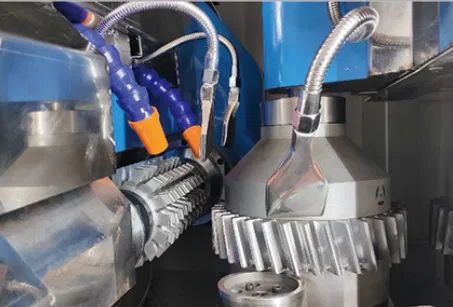
Types of CNC Hobbing Machines
The market offers several configurations to suit different production environments and gear types:
🔧 Horizontal CNC Hobbing Machines
The workpiece spindle is oriented horizontally. This is the most common configuration for mid-to-large gears and offers easy chip evacuation. Ideal for external spur and helical gears up to several meters in diameter.
🛠 Vertical CNC Hobbing Machines
The workpiece spindle is vertical. Preferred for small-to-medium gears in high-volume production. The vertical orientation aids automation with gravity-assisted loading and unloading, and is common in automotive gear lines.
⚙ Dry Hobbing (High-Speed) Machines
Run at high cutting speeds without coolant fluid, using coated carbide hobs and thermal management. Eliminates coolant cost and disposal; produces clean, dry chips. Widely adopted in automotive drivetrain production.
📈 5/6-Axis CNC Hobbing Machines
Advanced machines with additional controlled axes for crowned tooth forms, variable-lead worms, and simultaneous multi-operation capability. Used in aerospace, precision instrument, and electric vehicle drivetrain manufacturing.
What Gears Can a CNC Hobbing Machine Produce?
CNC hobbing is a versatile gear generation method capable of producing:
- ● Spur gears — the most common type; straight teeth parallel to the gear axis
- ● Helical gears — teeth cut at an angle to the gear axis for smoother meshing
- ● Worm gears — for high reduction ratios; requires specialized hob geometry
- ● Splined shafts — involute splines for torque transmission
- ● Sprockets — for chain drive systems
- ● Ratchet gears — for indexing mechanisms
Industries That Rely on CNC Hobbing Machines
CNC gear hobbing machines serve virtually every industry that uses mechanical power transmission:
Automotive
Transmission gears, differential gears, EV drivetrains
Aerospace
Actuator gears, landing gear components, helicopter gearboxes
Industrial
Gearboxes, reducers, conveyors, mining equipment
Energy
Wind turbine gearboxes, pump gears, compressor drives
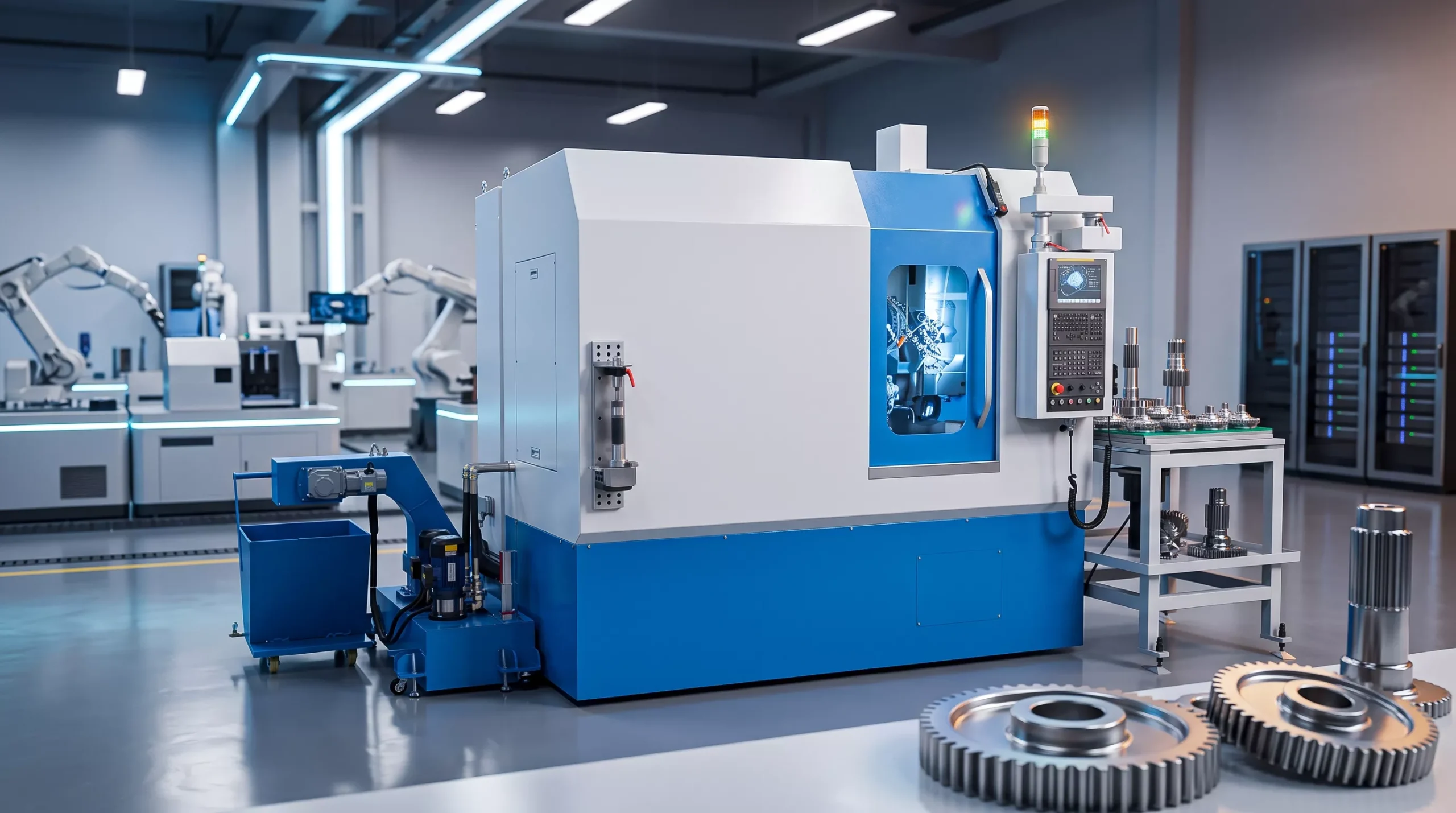
Our CNC Hobbing Machine Product
Looking for a reliable, high-precision CNC gear hobbing solution? Our CNC Hobbing Machine is engineered for demanding production environments, offering multi-axis CNC control, rigid machine construction, and broad compatibility with spur, helical, worm gears, and splined shafts.
👉 View CNC Hobbing Machine Specifications →
Partner With Us
We supply precision CNC hobbing machines to gear manufacturers across the globe. Whether you need a single machine for a specialty application or a fleet of machines for a high-volume production line, our team is ready to discuss your requirements, provide technical consultation, and offer competitive pricing.
📞 Contact Us for a CNC Hobbing Machine Quote
Frequently Asked Questions
What is the difference between a CNC hobbing machine and a gear shaper?
Hobbing uses a continuously rotating hob and is ideal for external gears in high-volume production. Gear shaping uses a reciprocating cutter and can produce internal gears, close-shoulder gears, and other forms that hobbing cannot access.
What gear accuracy class can CNC hobbing achieve?
High-quality CNC hobbing machines can achieve DIN 5 to DIN 7 accuracy class in the hobbed condition. With subsequent gear grinding, DIN 3 to DIN 5 is achievable for the most demanding applications.
What materials can be hobbed?
Most metals can be hobbed, including carbon steel, alloy steel, stainless steel, cast iron, aluminum, brass, and bronze. Certain plastics and composites can also be hobbed with appropriate tooling.