CNC Hobbing Machine with Automatic Loading: Reducing Labor Costs in Gear Manufacturing
Labor cost is one of the most significant variables in gear manufacturing economics — and one of the most amenable to reduction through automation. A CNC hobbing machine with automatic loading can produce gears 24 hours a day, 7 days a week, with minimal operator attendance. The result is a dramatic reduction in effective labor cost per piece, higher and more consistent throughput, and improved process quality. This guide explains how automatic loading works, what systems are available, and how to calculate the ROI of the investment.
The Labor Cost Challenge in Manual Hobbing
In a manually operated hobbing cell, the operator performs:
- ● Load blank onto arbor/chuck and secure
- ● Initiate cycle start
- ● Wait for cycle completion (idle time — 40–80% of cycle time for fast-cycle gears)
- ● Unload finished gear and place in output container
- ● Inspect sample gears at regular intervals
For a gear with a 30-second hobbing cycle, the operator performs a load/unload every 40–50 seconds — equivalent to 80+ manual operations per hour. Over a shift, this is exhausting and leads to fatigue-related errors and inconsistent clamping. And the machine produces nothing when the operator is on break, at lunch, or between shifts.
Automatic Loading System Options
🤖 Collaborative Robot (Cobot) Loading
A lightweight collaborative robot (cobot) — such as Universal Robots UR10, FANUC CRX, or KUKA LBR — loads and unloads gears directly from an input/output tray. Cobots can operate without safety fencing in human-shared spaces (within payload and speed limits), making them ideal for retrofitting onto existing hobbing machines without major facility changes. Setup is fast (typically 1–2 days); programming is done via teach pendant without specialist robot programmers. Best for parts up to 5–10 kg and medium cycle times.
🤖 Industrial Robot Cell
A high-speed industrial robot (FANUC M-10, ABB IRB 2600, KUKA KR 20) in a safety-fenced cell handles faster and heavier parts than cobots. Typical payload 10–50 kg; cycle rates up to 60+ loads/unloads per hour. Standard in automotive and high-volume industrial gear production. Requires dedicated safety perimeter, cell design, and robot programming. Longer commissioning time but highest throughput.
🤖 Gantry (Portal) Loader
A linear overhead gantry can serve one or multiple hobbing machines. Parts travel on a conveyor below the gantry; the gantry’s vertical pick head loads and unloads with high repeatability. Well-suited for dedicated high-volume lines with one or a small number of gear types. Less flexible than robot cells but very high throughput and excellent for vertical hobbing machines with top-loading access.
🤖 Bar/Disc Feeders
For small gears machined from bar or short disc blanks, vibratory bowl feeders or step feeders can orient and feed blanks automatically to the machine without a robot. Lower cost than a robot cell; suitable for simple, lightweight, high-volume applications (small sprockets, small splines, etc.).
How to Calculate Automatic Loading ROI
| Factor | Manual Operation | Automated Loading |
|---|---|---|
| Daily production hours | 16 hrs (2 shifts × 8 hr) | 22 hrs (3 shifts or near-continuous) |
| Machine utilization | 70–80% | 88–95% |
| Operator hours per day | 16 (2 operators × 8 hr) | 2–4 (monitoring only) |
| Annual parts output | Baseline | +50–80% vs. manual |
| Labor cost per part | Baseline | -60–80% vs. manual |
Typical payback period for a cobot loading cell: 12–24 months. For an industrial robot cell: 18–36 months, depending on volume and labor rates.
What to Look for in an Automation-Ready CNC Hobbing Machine
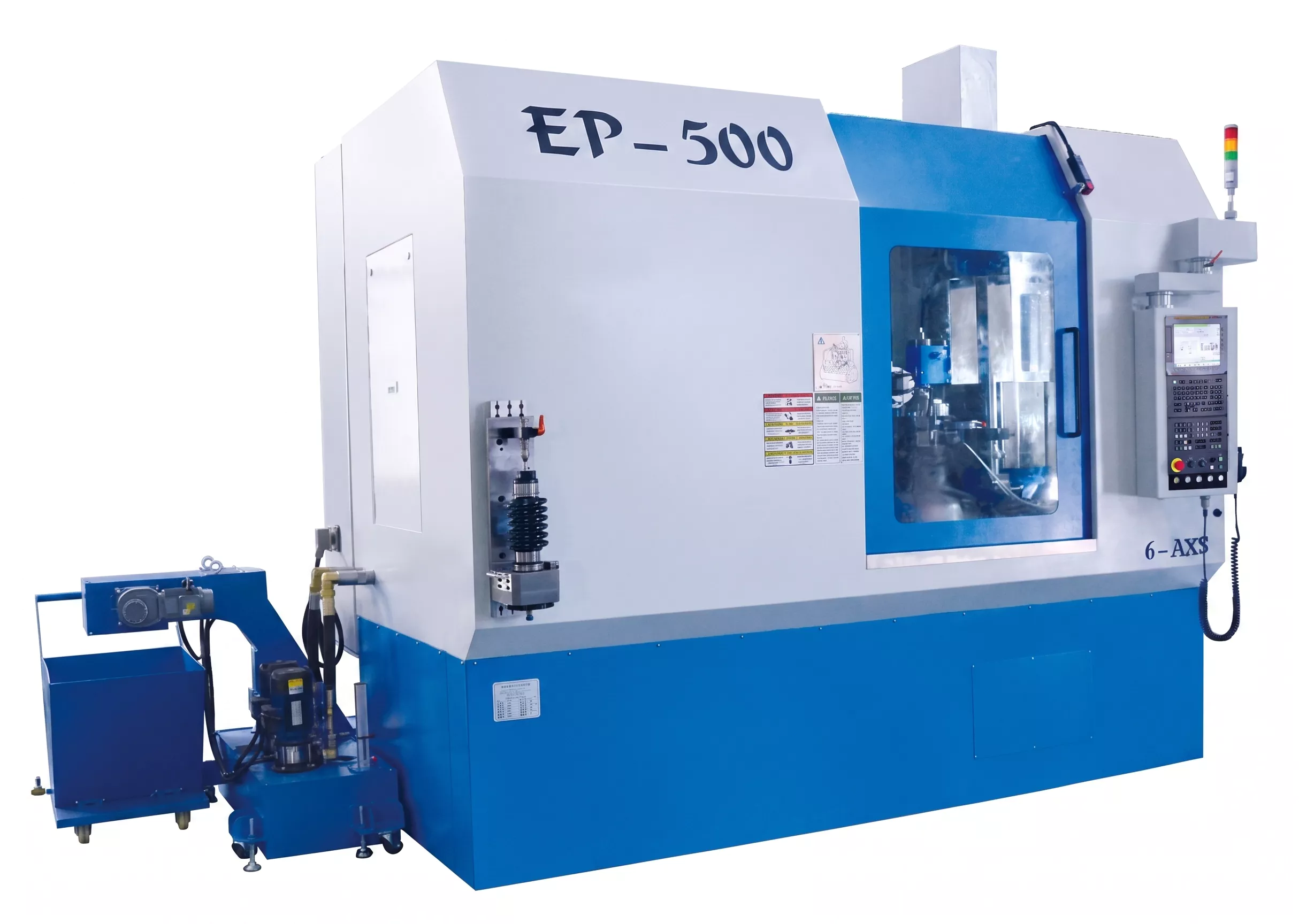
- ● Pneumatic or servo-actuated door — essential for robot loading; manual swing doors cannot be safely automated
- ● Standard robot/PLC interlock signals — pre-wired I/O for door, chuck, cycle, alarm enables fast robot integration
- ● Defined part pick/place position — the arbor or chuck center must be at a known, fixed position for robot repeatability
- ● Automatic chip conveyor — manual chip clearing stops automated production; a reliable conveyor is non-negotiable for unattended operation
Our Auto-Loading-Ready CNC Hobbing Machine
Our CNC Hobbing Machine is supplied automation-ready: pneumatic door, pre-wired robot interlock I/O, and defined part pick position. We can also supply the machine as a complete automated cell with robot, EOAT, input/output conveyor, and safety enclosure — turnkey and ready for production.
👉 View Auto-Loading CNC Hobbing Machine →
👉 Request Automated Cell Proposal →