Integrating CNC Hobbing Machines into Automated Gear Production Lines
The era of the standalone CNC hobbing machine — operated manually by a skilled technician who loads and unloads each part — is giving way to fully automated gear production cells where the hobbing machine is one node in an interconnected manufacturing system. Integrating CNC hobbing machines into automated lines enables dramatically higher spindle utilization, lower labor cost per piece, and tighter process control than manual operation. This guide covers the key integration considerations, automation options, and planning steps for a successful automated hobbing line.
Why Automate Your CNC Hobbing Line?
Lights-Out Production
Automated cells run 24/7 without operators — adding 8–16 productive hours per day versus single-shift manual operation
Lower Cost Per Piece
Automated loading eliminates labor cost for load/unload — typically 15–40% of cycle time in manual operations
Consistent Quality
Robots load/unload with exactly the same force and position every cycle — eliminating clamping variability that can affect gear runout
Data Collection
Automated cells enable 100% part tracking, cycle-time monitoring, and real-time process data for SPC and MES integration
Automation Architecture Options
🤖 Option 1: Robot Loading Cell (Single Machine)
A 6-axis industrial robot is mounted adjacent to the hobbing machine. The robot picks gear blanks from an input tray or conveyor, loads them into the machine chuck/arbor, and unloads finished gears to an output tray or conveyor. End-of-arm tooling (EOAT) is custom-designed for the specific gear geometry. This is the most common automation architecture for medium-volume production (10,000–500,000 gears/year).
🤖 Option 2: Gantry Loading System
A gantry (overhead linear robot) serves one or multiple hobbing machines along its travel range. Parts move on conveyors or pallets beneath the gantry; the gantry picks and places parts to machine chucks. Gantry systems excel when serving multiple identical machines in a line — one gantry can tend 2–4 hobbers and provide higher throughput per robot investment than individual cell robots.
🤖 Option 3: Integrated Production Line (Turning + Hobbing + Deburring)
In the highest-volume automotive production environments, the hobbing machine is one station in a fully integrated line that also includes CNC turning (blank preparation), automated chamfering/deburring, inline washing, and measurement. Parts transfer between stations on conveyor pallets or via inter-machine robots. All machines are coordinated by a central PLC or MES system with production monitoring, alarm management, and automated traceability.
Key Machine Features Required for Automation Integration
| Required Feature | Why It Matters |
|---|---|
| Standardized part pick position | Robot must know exactly where to pick/place part; requires defined chuck/arbor reference position |
| Interlock signals (PLC I/O) | Machine-robot handshake: door open/close, chuck open/close, cycle start/end, alarm status |
| CNC part program management | MES can call or confirm the active part program; supports mixed-model production |
| Data output (OPC-UA / PROFINET) | Real-time data to MES: cycle time, part count, spindle load, alarm history |
| Chip management | Automated chip conveyor prevents chip accumulation from stopping automated operation |
| Automated door | Robot loading requires pneumatic or servo-driven door; manual swing doors are not compatible |
Planning Your Automated Hobbing Cell
- Define part family: What gear types, sizes, and volumes will the cell produce?
- Cycle time analysis: Calculate net cycle time (hobbing) + transfer time + load/unload time to ensure the cell meets takt time requirements.
- Robot selection: Payload, reach, and repeatability must match the gear weight, size, and required position accuracy.
- EOAT design: End-of-arm tooling must handle blank and finished gear reliably, including chip-contaminated surfaces.
- Cell layout: Plan blanks input, finished part output, chip evacuation, and coolant drain within the cell footprint.
- Safety: CE-compliant safety fencing, light curtains, and safety PLC for operator interaction during cell operation.
Our Automation-Ready CNC Hobbing Machine
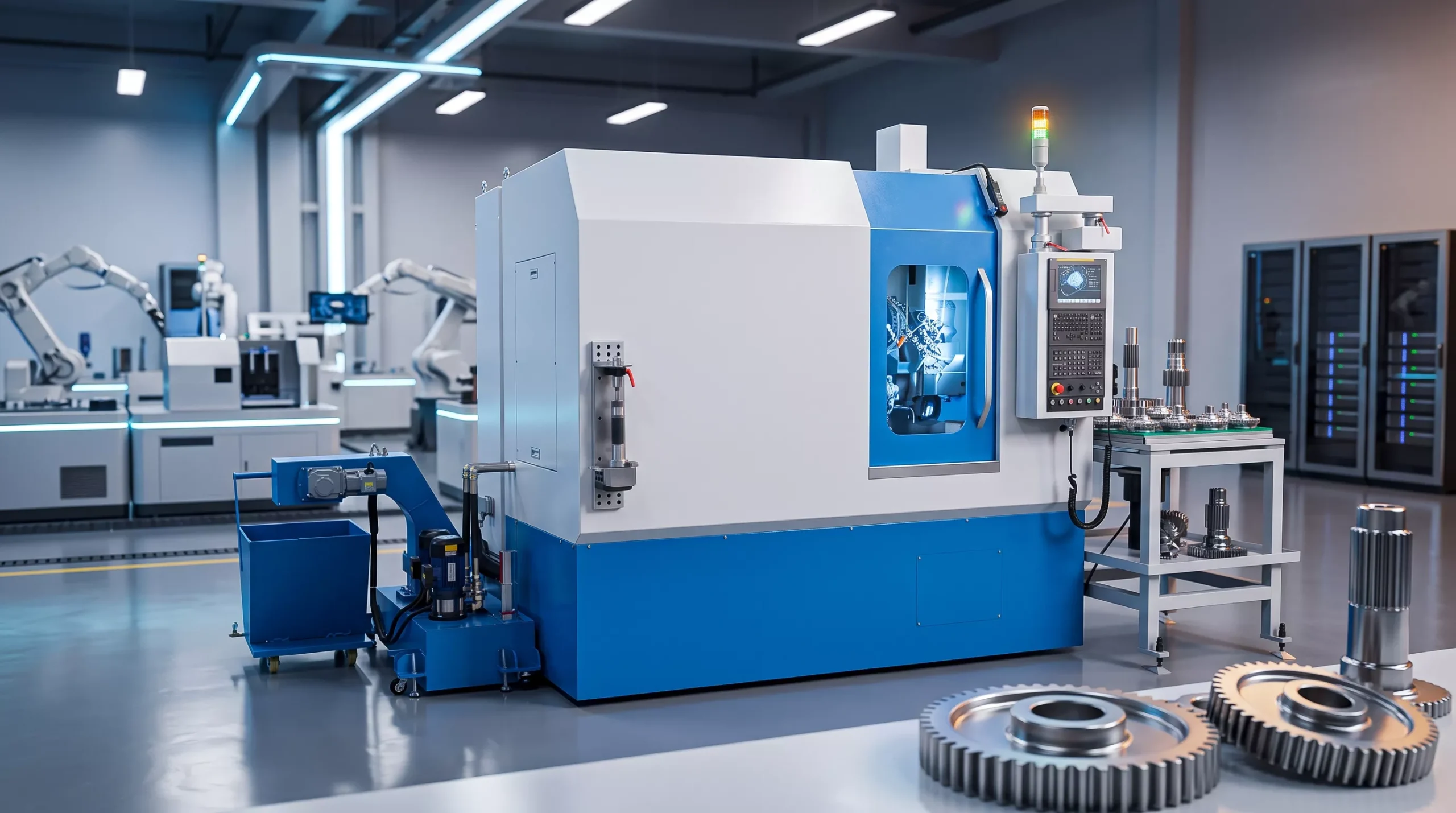
Our CNC Hobbing Machine is designed from the ground up for automated cell integration — with standardized PLC interfaces, OPC-UA data output, automated door options, and robot-compatible loading positions. We support customers through the full cell integration process from machine selection through production startup.
👉 View Automation-Ready CNC Hobbing Machine →
👉 Discuss Your Automated Hobbing Line Project →