Two processes dominate precision gear manufacturing: CNC gear hobbing and CNC gear grinding. They are not competing alternatives — in most high-precision gear production lines they are sequential operations on the same part. But understanding which process does what, what accuracy each achieves, and how to decide whether your application needs both is essential for anyone specifying gear manufacturing equipment or evaluating a production process.
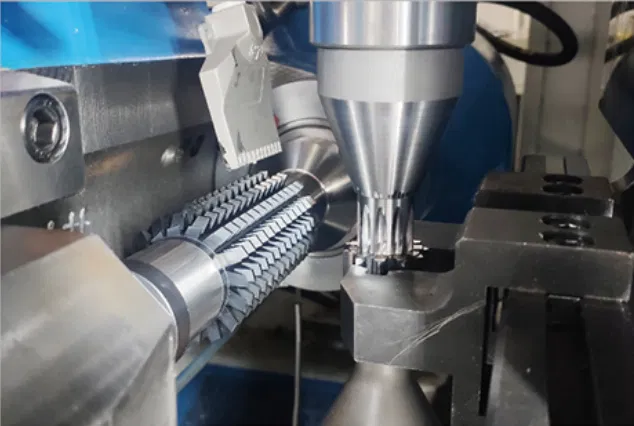
CNC gear hobbing: the productive soft-cutting stage before heat treatment
The Fundamental Distinction: Soft Cutting vs Hard Finishing
CNC gear hobbing is a soft-cutting process. It removes material from an un-hardened gear blank using a rotating hob cutter in a continuously generated multi-axis motion. Hobbing achieves high material removal rates — it is the fastest way to put a gear tooth form on a blank — and typically achieves DIN 5 to DIN 9 gear accuracy in the soft state. The hobbed gear then goes through heat treatment (typically case hardening and quenching), which introduces dimensional distortions: growth, ovality, and twist that degrade the gear accuracy from its pre-heat-treatment state.
CNC gear grinding is a hard-finishing process. Applied after heat treatment, it removes the distortions introduced by hardening and brings the gear to its final dimensional accuracy — typically DIN 4 to DIN 7 — using an abrasive grinding wheel under precise CNC control. Gear grinding is significantly slower than hobbing, and the grinding wheel is a consumable with a cost and life cycle. But it is the only way to achieve the accuracy classes required for automotive transmissions, aerospace actuation gears, and wind turbine main gearbox components.
Process Comparison at a Glance
| Parameter | CNC Gear Hobbing | CNC Gear Grinding |
|---|---|---|
| Workpiece State | Soft (un-hardened) | Hard (post heat treatment) |
| Typical DIN Accuracy | DIN 5 to DIN 9 | DIN 4 to DIN 7 |
| Material Removal Rate | High — primary stock removal | Low — finishing only, small stock |
| Cutting Tool | Gear hob (HSS or carbide) | Grinding wheel (corundum or CBN) |
| Surface Finish (Ra) | Ra 1.6 to Ra 6.3 um typical | Ra 0.4 to Ra 1.6 um typical |
| Process Speed | Fast cycles, high throughput | Slower — per-tooth or generating |
| Tooling Cost | Moderate; hob can be resharpened | Wheel cost; CBN wheels last longer |
| Profile Flexibility | Standard involute and special forms | Full profile correction and tip/root relief |
| Typical Application | All gears: first operation before hardening | Hardened precision gears requiring DIN 5 or better |
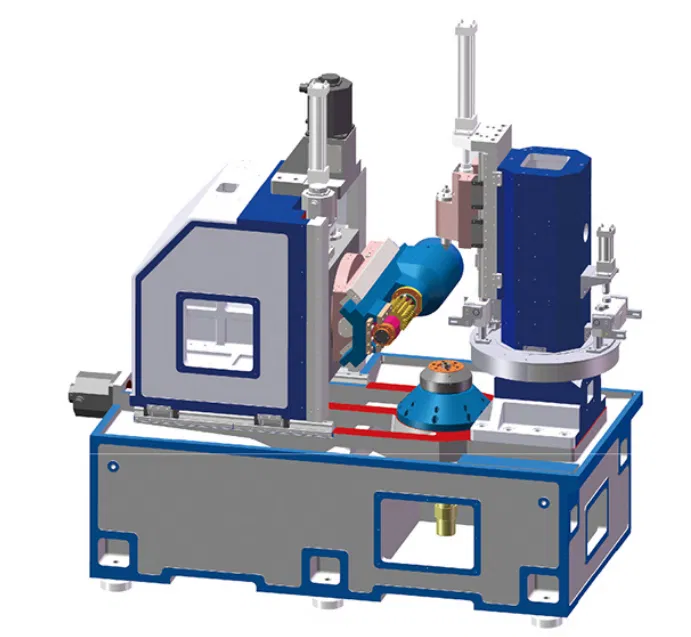
CNC hobbing system: the electronic gearbox synchronises all axes to generate accurate gear profiles at high production rates
When to Use Hobbing Only
Not all gear applications require post-grind finishing. Hobbing alone is sufficient when:
✅Gear Accuracy DIN 7 or Coarser
Agricultural, construction, and general industrial gears where DIN 7 to DIN 9 is acceptable — hobbing delivers this directly without secondary operations.
✅Subsequent Shaving is Used
Gear shaving after hobbing but before hardening can achieve DIN 5 to DIN 7. This eliminates the grinding stage for many medium-accuracy applications.
✅Through-Hardening at Low Precision
Through-hardened gears where post-hardening distortion is acceptable within the tolerance band — hobbing to DIN 6 pre-hardening remains within DIN 8 post-hardening in many cases.
✅High Volume, Lower Accuracy
Power tool gears, consumer appliance drives, and general machinery gears where throughput economics outweigh the marginal accuracy improvement from grinding.
When Hobbing + Grinding is Required
The combination of hobbing and grinding is essential in these scenarios:
DIN 5 or Better Required
Automotive transmission gears, EV reduction drives, aerospace actuation gears, and wind turbine planet gears all require DIN 5 or better on the hardened gear. Only grinding achieves this after hardening.
Noise and Vibration Critical
Gear noise is driven by tooth form deviation, pitch error, and surface finish. The Ra 0.4 to Ra 0.8 um surface finish from gear grinding reduces gear mesh excitation forces compared to a hobbed surface at Ra 2.5 um.
Profile Modifications Required
Tip relief, root relief, crowned lead, and other intentional involute modifications that compensate for deflection under load are only achievable by gear grinding — hobbing produces the basic involute form.
Aerospace and Medical Certification
Regulated industries requiring documented dimensional traceability on every part need the CMM-verified gear accuracy reports that precision grinding with in-process gauging provides.
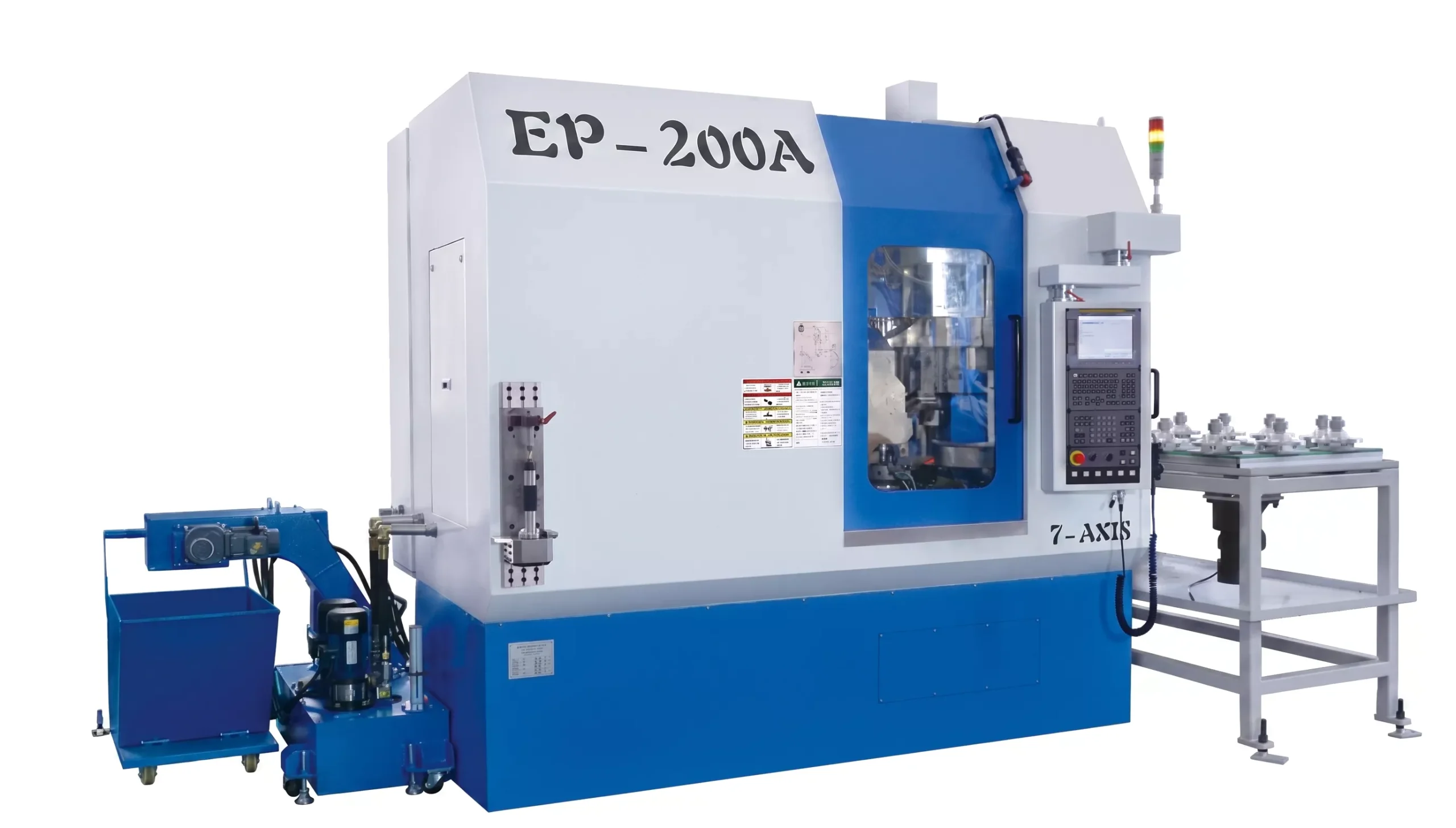
EP-200 CNC hobbing machine: M6 vertical configuration for industrial gearbox and construction equipment production
The Typical Precision Gear Production Sequence
For most precision gear applications, the production sequence combines both processes:
| Stage | Operation |
|---|---|
| 1 | Blank turning — rough OD, bore, face on CNC lathe |
| 2 | Gear hobbing — generate tooth form on soft blank |
| 3 | Deburring and chamfering (often integrated with hobbing) |
| 4 | Heat treatment — case hardening, carburising, quenching |
| 5 | Straightening / hard turning (where needed) |
| 6 | Gear grinding — hard finish to final DIN accuracy |
| 7 | Final inspection — CMM gear measurement report |
Cost Structure: Where Hobbing and Grinding Each Add Value
A common misconception is that gear grinding is simply “more accurate hobbing” — and therefore always preferable if budget allows. In practice, the two processes have complementary cost structures. Hobbing removes 95% of the gear tooth volume at high material removal rates with relatively low tooling cost per part. Grinding removes a small stock (typically 0.1mm to 0.3mm per flank) at low material removal rate but produces the accuracy and surface finish that the application requires.
Specifying grinding where hobbing would be sufficient wastes machine time and adds tooling cost. Specifying hobbing where grinding is required produces scrap or warranty claims. The right question is not “hobbing or grinding?” but “what does this specific application require, and what is the most efficient process sequence to achieve it?” — which is exactly the starting point of our application engineering process.
If you are unsure whether your application requires gear grinding after hobbing, share your gear drawing and required accuracy class via our engineering enquiry page. Our team will identify the most efficient process sequence for your specification.
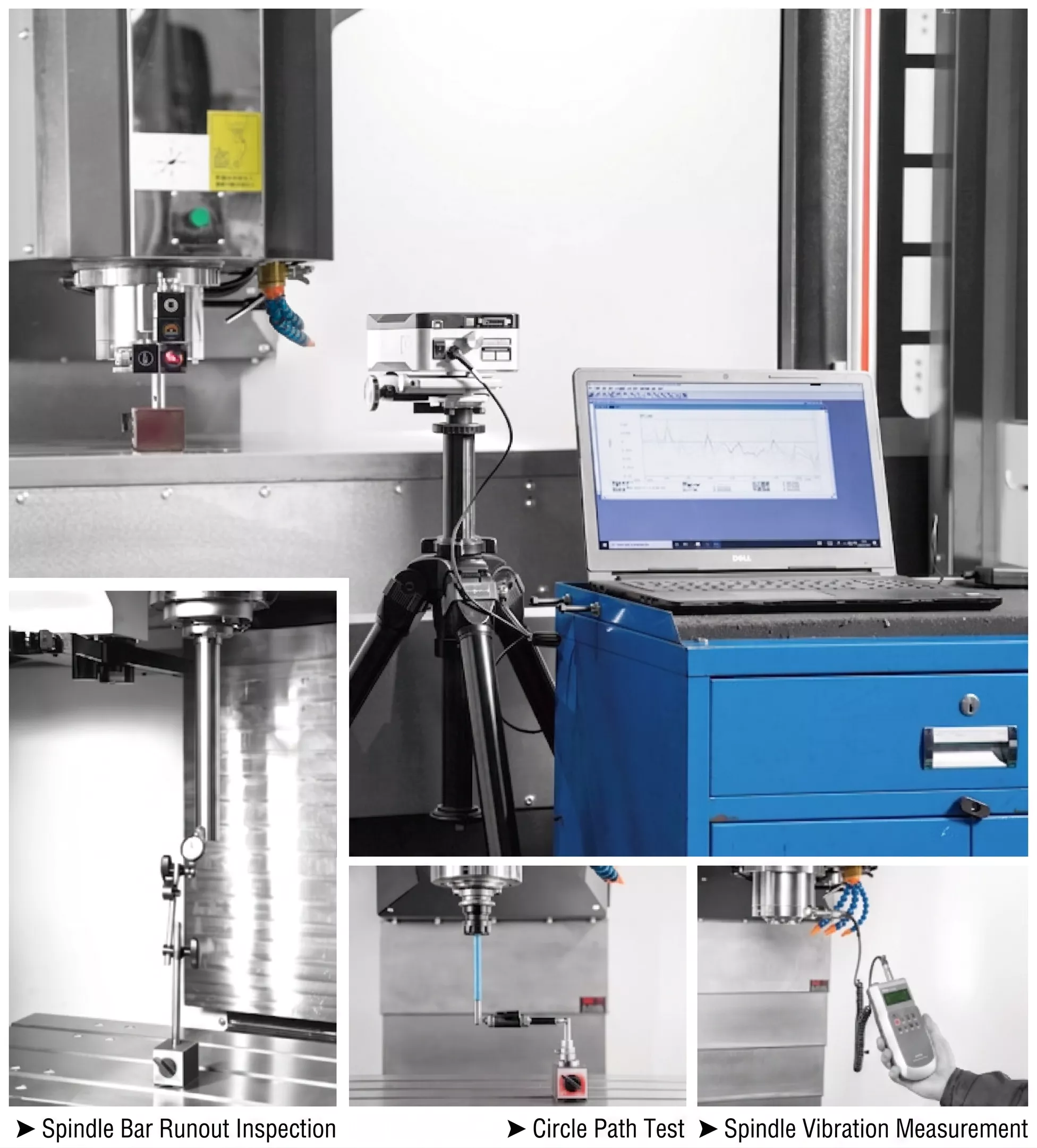
CMM inspection: every precision gear is measured and documented against DIN 3962/3963 standards after grinding
Equipment Selection: Hobbing Machine, Grinding Machine, or Both?
For manufacturers setting up a new gear production line, the equipment selection follows directly from the application accuracy requirements. If your gear family requires DIN 7 or coarser, a CNC hobbing machine is likely sufficient. If DIN 5 or better is required on hardened gears, both a hobbing machine and a gear grinding machine are needed — and the hobbing machine should be selected to complement the downstream grinding process, not to maximise pre-grind accuracy (which is often more expensive per part than achieving that accuracy in the grinding stage).
Our EP-series covers the full CNC hobbing range from EP-100 (Phi 100mm / M3) through EP-500 (Phi 500mm / M14). For manufacturers who also need gear grinding capability, explore our full precision machining range or contact our engineering team via the enquiry page for a complete production cell recommendation.
Can I achieve DIN 6 accuracy with hobbing alone, without grinding?
In the soft state, yes — high-quality CNC hobbing machines with DIN 3968 Class AA hobs can achieve DIN 5 to DIN 6 on un-hardened gears. But after case hardening and quenching, distortions typically shift the gear to DIN 7 to DIN 9. If you require DIN 6 on the hardened gear, gear grinding after hardening is necessary.
What is the typical stock allowance left on a hobbed gear before grinding?
Standard practice leaves 0.1mm to 0.3mm of stock per flank for the grinding allowance, depending on the module and the heat treatment distortion expected for the material. Leaving too much stock increases grinding time and wheel wear; too little risks insufficient material removal to correct hardening distortion.
Does hobbing accuracy affect grinding cycle time?
Yes, significantly. The closer the pre-grind hobbing accuracy, the less stock the grinding wheel needs to remove and the faster the grinding cycle. A well-controlled hobbing operation can reduce grinding cycle time by 20% to 40% compared to a poorly controlled hobbing operation with high distortion, even on the same part.
Specifying a CNC hobbing machine, gear grinding machine, or a complete gear production cell? Submit your application details for a no-obligation process and equipment recommendation from our engineering team.