Automotive transmission gear production is the highest-volume, highest-consistency application in the CNC hobbing industry. A single passenger car gearbox contains 20 to 40 individual gears, an EV reduction unit contains 4 to 8, and production volumes for a single vehicle programme can run to hundreds of thousands of parts per year. Every one of those parts must meet DIN 6 or better on the hardened gear, with tooth-to-tooth pitch deviation and profile form deviation documented by CMM and reported against the design specification. This article covers the specific machine characteristics, process parameters, and performance benchmarks that matter for automotive CNC hobbing applications.
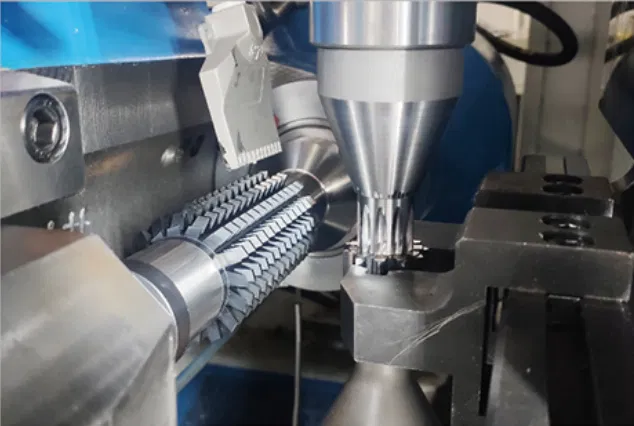
EP-150: thermal deformation prevention and direct-drive architecture — the combination required for Cpk-compliant automotive transmission gear production
The Automotive Gear Production Specification
Automotive transmission gears have a tighter specification package than most other gear applications. The key production requirements that distinguish automotive from general industrial gear hobbing are:
DIN 5 to DIN 6 Required
Automotive transmission gears must achieve DIN 5 to DIN 6 on the hardened gear. This is not achievable by hobbing alone — a soft-hobbing to approximately DIN 5 pre-grind accuracy followed by gear grinding to DIN 5 post-hardening is the standard process sequence.
100% CMM Documentation
Automotive supply chains typically require documented gear measurement data (CMM gear reports) for every production batch, with ff, fp, Fp, fHα, and Fhβ reported against drawing tolerances. Statistical process control (SPC) on these parameters is standard.
Cpk ≥ 1.33 Across Full Shift
Part-to-part consistency across the full production shift — not just the first-off — is what automotive Cpk targets require. This directly drives the thermal stability requirement for the hobbing machine.
⏱️High Volume, Short Cycle Time
Passenger car transmission programmes at 300,000 to 1,000,000 gears per year demand cycle times of 20 to 90 seconds per part depending on module and tooth count. Machine utilisation and OEE targets typically exceed 80%.
The Pre-Grind Accuracy Target from Hobbing
In an automotive gear production line, the hobbing machine’s accuracy target is not the final gear accuracy — it is the pre-grind accuracy that achieves the target final accuracy efficiently in the downstream grinding operation. The tighter the pre-grind accuracy, the less stock the grinding wheel must remove, the faster the grinding cycle, and the longer the grinding wheel life. The looser the pre-grind accuracy, the longer the grinding cycle and the higher the wheel cost per part.
For automotive gears ground to DIN 5 or DIN 6, the target pre-grind hobbing accuracy is typically DIN 7 to DIN 8 on the soft gear. The 0.1mm to 0.2mm grinding stock per flank removes the heat treatment distortion (typically 1 to 3 DIN classes of degradation) and brings the gear to its final accuracy. A well-controlled hobbing operation producing consistent DIN 7 pre-grind accuracy enables a grinding cycle of 60 to 120 seconds on a typical passenger car gear. A poorly controlled hobbing operation at DIN 9 pre-grind requires a longer grinding cycle to remove more stock and correct more distortion.
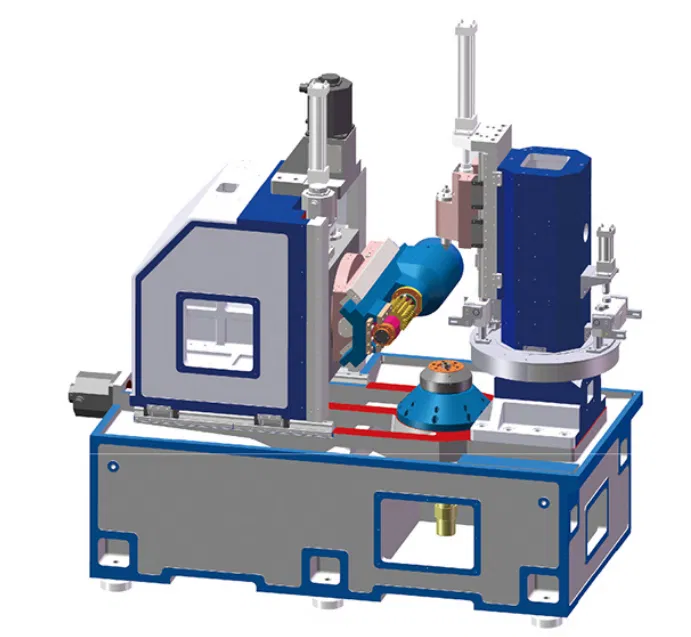
Electronic gearbox: changing from a 35-tooth 3rd gear to a 28-tooth 2nd gear is a program call, not a physical setup — critical for automotive multi-variant production lines
Cycle Time: What Determines It and How to Calculate It
CNC hobbing cycle time is determined by four factors: the axial feed rate, the face width, the number of passes, and the non-cutting time (approach, retract, index). For a single-pass climb cut:
| Cycle Time Component | Typical Range for Automotive Gears (M2 to M4) |
|---|---|
| Axial feed rate | 1.0 to 3.0 mm/rev workpiece — higher for roughing, lower for finishing |
| Face width / cycle time | 12mm face / 0.5mm/rev feed / 800rpm table ≈ 1.8 seconds per pass |
| Approach and retract | 0.5 to 2.0 seconds typical on CNC machine with rapid traverse |
| Tool change (if required) | 1.6 to 2.8 seconds T-T on standard arm changer; add if hob change in cycle |
| Total cycle time range | Typically 15 to 90 seconds for automotive disc gears M2 to M4 |
Hob Life and Cost Per Part
Hob life — the number of parts produced per hob or per resharpening — is the largest variable in hobbing cost per part after machine depreciation. Automotive production lines are sensitive to hob life because hob cost per part directly affects the programme’s contribution margin. The key parameters that determine hob life in automotive production are:
Hob Material Grade
M35 HSS hob: 500–2,000 parts per sharpening depending on module and material. Solid carbide hob: 3,000–15,000 parts between resharpenings. PM HSS hob (ASP2052, S390): intermediate performance. Carbide hobs cost more per unit but typically lower cost per part.
↔️Hob Shift Strategy
Shifting the hob incrementally along its Y-axis between parts distributes wear across a longer hob length. On a machine with 180mm of Y-axis travel (EP-150 through EP-350), an aggressive tangential shift strategy can multiply effective hob life by 2x to 4x compared to a non-shifting approach on the same hob.
⚡Cutting Speed
Higher cutting speeds (driven by higher B-axis rpm) improve productivity but reduce hob life. For M3 gears in 20MnCr5, a carbide hob at 200 m/min cutting speed will produce fewer parts per sharpening than the same hob at 120 m/min. The optimum speed is a balance of cycle time and hob cost per part.
️Dry vs Wet Cutting
Dry cutting with carbide hobs eliminates coolant cost and eliminates the thermal shock that shortens hob life in wet carbide cutting. Many automotive Tier-1 producers have moved to dry cutting for M1.5 to M3 applications.
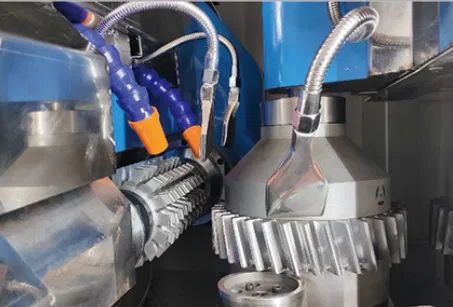
EP-200 (left) and EP-350 (right): the mid-range EP-series machines covering M6 to M8 — used in automotive final drive gear, differential, and heavy transmission production
Machine Requirements for Automotive Hobbing
Based on the requirements above, the machine specification checklist for automotive gear hobbing applications is:
| Requirement | Why It Matters for Automotive Production |
|---|---|
| Direct-drive B and C axes | Required for DIN 5 to DIN 6 pre-grind accuracy; periodic drive errors from gear-driven systems degrade profile and pitch consistency |
| Active thermal compensation | Required for Cpk ≥ 1.33 across full shift; eliminates shift-to-shift tooth spacing drift |
| Electronic gearbox (FANUC 0i-MF Plus or equivalent) | Required for rapid variant changeover without physical setup; essential for multi-model lines |
| Hob shift Y-axis travel ≥ 150mm | Required for aggressive shift strategies that achieve automotive hob life targets |
| C-axis table torque rated to module | Required to prevent table micro-slip that produces pitch deviation on every part |
| CMM acceptance test report | Required documentation for automotive supplier qualification |
For automotive gear production cells combining CNC hobbing with downstream gear grinding, the hobbing machine’s contribution to final part accuracy and per-part cost is just as significant as the grinding machine. Optimising the hobbing process — pre-grind accuracy, cycle time, and hob life — delivers measurable improvements in total cell productivity and cost-per-part. Contact our application engineering team for a cell-level analysis.
What module range covers most passenger car transmission gears?
Passenger car transmission gears are predominantly M1.5 to M3.5. EV reduction unit gears are often M2 to M4. Final drive gears (ring and pinion) may reach M4 to M6. Heavy vehicle transmissions extend to M6 to M8.
Is dry cutting or wet cutting more common in automotive hobbing?
Both are used, depending on the module, hob material, and production volume. Dry cutting with solid carbide hobs is increasingly common for fine-pitch M1.5 to M3 automotive gears because it eliminates coolant costs, reduces thermal shock on carbide hobs, and produces a cleaner machining environment. Wet cutting remains dominant for M4 and above where the higher heat generation makes dry cutting challenging.
What is the typical machine life for an automotive gear hobbing machine?
CNC hobbing machines in automotive production typically operate for 15 to 20 years before replacement, with planned spindle bearing replacements at 8 to 12 year intervals. The electronic and software components (CNC control cards, servo drives) typically require refreshing at 10 to 15 years as spare parts availability for older control generations declines.
Running an automotive transmission gear production line, or planning a new EV drivetrain gear cell? Submit your gear family and production volume for a process and machine recommendation from our application engineering team.